Spots on a surface
Spots (white, crystal-like or, on the contrary, darker with an oily look) can be particularly frustrating for cookie decorators, because they appear hours, and even days, after the cookie has been finished and tightly packed.
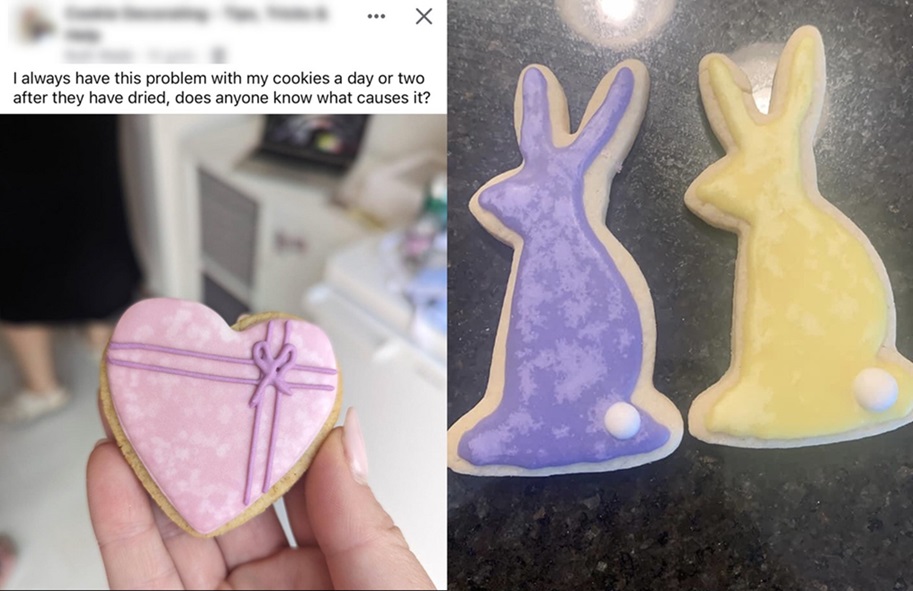
This issue has, basically, four causes:
1. Butter bleed. This means that the fat from the cookie has seeped into the icing (your cookie is literally "leaking" fat), leaving dark spots on the surface. It may happen when you decorate freshly baked cookies (you bake and decorate on the same day).
2. Your cookie isn't dry enough. Always put your icing only on a hard and dry cookie; the best option is to put your cookie to a dehydrator or an oven for half an hour before decorating.
3. Problems with base consistency. Properly mixed base icing is very stable and thus less prone to separating and/or crystallization.
4. "Stale" icing: mixed, dyed icing loses its stability very fast and separates. Separation means that the liquids separate from the solids used in your icing. Generally speaking, the thinner the icing, the faster it will separate.
How to fix these flaws?
If you are in a hurry and can't afford preparing new batch of icing and starting over, you may consider redecorating your project.
- You can hide spots under 3D decorations made of stiff icing (roses, flowers or RI transfers).
- Cover spots by drawing or painting over them (with edible markers, gel colors solved in alcohol or both).
- For advanced users only: you may consider covering spots by using an airbrush.